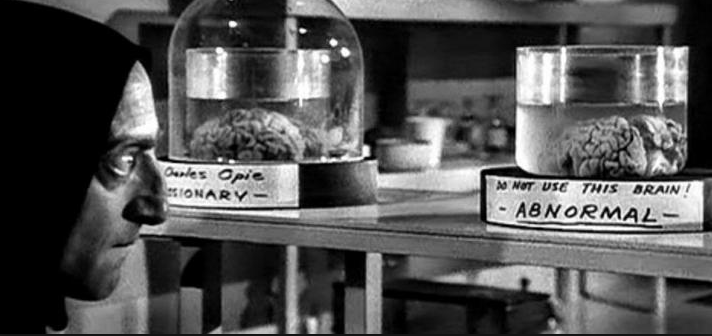
If I was forced to pick a Mount Rushmore of directors, Mel Brooks is getting a spot. No question. For many, myself included, Young Frankenstein is his crowning achievement.
It’s one of those movies that has just burrowed into our collective cultural attic. It’s hard to look at a rotating bookcase without thinking, “Put the candle back!” Or hear a horse whinny without whispering “Frau Blücher.” And you certainly can’t talk about brains without bringing up Marty Feldman’s “Abby Normal” scene.
But there’s one specific scene that popped out of the fragged bits of my memory recently while I was reading the coverage from NVIDIA’s and Akamai’s latest grid announcements. Admittedly, my brain goes places and makes connections others, luckily, don’t.
It’s the scene where Peter Boyle — the movie’s Monster — wanders into the cottage of a lonely, blind hermit, played by a nearly unrecognizable Gene Hackman. The hermit, desperate for a friend, offers to light the Monster’s cigar. But because he can’t see, he misses the cigar entirely and holds the flame directly to the Monster’s index finger.
What follows is pure comedic magic: The Monster stares at his flaming finger with a dull, quiet curiosity. He doesn’t scream. He doesn’t pull away. There is this agonizing, three-second delay while the signal travels from the hand to the head. Only then does he let out a harrowing roar and crash through the wall.
“Wait!” Hackman shouts after him. “Where are you going? I was going to make espresso!”
It’s a hilarious bit. But in 2026, it’s also the perfect metaphor for the biggest bottleneck in AI.
The Genius in the Jar
Today’s AI is a lot like that Monster. We’ve built these distinguished brains — massive, multi-trillion parameter models that can pass the Bar exam and write poetry — but we’ve kept them in jars. Specifically, jars located in massive, centralized data centers.
This is what the industry calls centralized architecture. It’s where training happens: the massive, heavy-lift process of teaching the monster how to “put on the Ritz.”
But there’s a big difference between a brain being smart and a brain being present. In the lab, a two-second delay is a rounding error. In the real world — the world of self-driving cars, robotic surgery, or real-time fraud detection — that delay is a burning finger.
A Quick ELI5 Science Lesson
To understand why this matters, we have to look at our own biology. You have a central nervous system (the brain) and a peripheral nervous system (the nerves).
- The Brain handles the big stuff: Reasoning, planning, and debating which Mel Brooks movie is actually the best (good luck with that)
- The Nerves handle the reflexes.
If you touch a hot stove (or a blind man’s lighter), your spinal cord makes the decision to pull your hand away before your brain even registers the heat. That’s called proprioception, the sense of where your body is in space and how it’s reacting to the world.
Modern AI has a massive IQ, but it has zero proprioception. It’s a genius behind a glass wall. It doesn’t feel the fire until the data is packaged, shipped 2,000 miles to the Jar, processed, and mailed back. By then, the hermit has already lit your finger and moved on to the espresso.
Closing the Circuit
The future of AI and what we’re seeing in these NVIDIA and Akamai grid announcements, isn’t about making the brain bigger. We need the reasoning to stay in the cloud (the brain), but we need the reflex to live at the edge (the nerves). The goal is a continuum where the AI can feel the environment in the neighborhood where it’s happening, reacting in milliseconds rather than seconds.
The missing piece of this puzzle hasn’t been the hardware; NVIDIA’s GPUs have that more than covered. It’s the orchestration. How do you decide what needs a reflex and what needs reasoning? How do you make the brain and the nerves act as one integrated being?
Connecting the Dots
My neighborhood poker buddies once asked how I seem to know so much about so many random things. I told them it’s my job to make connections — to see how a 50-year-old comedy sketch might actually be the blueprint for a global AI grid.
But the truth is, the most important connections are the ones the brain itself misses when it’s disconnected from the rest of its senses.
That’s exactly where we are with AI today. We’ve built the brain in the cloud, and we’ve built the nerves at the edge. But for the last few years, they’ve been operating like that scene in the cottage: the brain is doing the reasoning, but it’s completely numb to the fire on its own hand.
We’re finally connecting the two. Orchestration, like Akamai announced, is allowing the intelligence to finally feel the environment it’s supposed to be operating in.
And who knows? If we get the orchestration right, maybe we’ll actually stick around long enough to enjoy the espresso.