Not every idea deserves to live. But plenty of good ones die before they get a chance. They vanish under the weight of calendars, inboxes, and interruptions — the thousand small frictions that erase a thought before it has time to become something real.
Leonardo da Vinci lived this problem as fully as anyone we remember. His notebooks are filled with flashes of brilliance that never moved an inch toward becoming real. They reveal a mind where ideas arrived faster than execution, and a compulsion to record them, even when they might never be completed. They stayed ink on paper. Imagine if he’d had something to carry those sparks just a little further.
Today, we do.
AI gives us the inch Leonardo never had: not just a way to keep an idea alive, but a way to work it before it’s fully formed. A sentence can be pushed, expanded, challenged. A paragraph can be reshaped or broken apart. A rough draft becomes something you can interrogate. All of it quickly enough to learn whether there’s anything there worth shaping at all.
But that inch isn’t enough.
Ideas still need something only humans provide: judgment.
I learned this early in my career working with Mike Zisman and Larry Prusak on IBM’s knowledge management business (well, they worked on it; I helped them communicate it). Much of that work, as I remember it, centered on the difference and interplay between explicit and implicit knowledge. What you can write down versus what you simply know. Facts versus instinct.
AI is extraordinary at the explicit. It can generate variations, surface patterns, and produce options at scale. But it can’t do the tacit work. It can’t feel the off-note in a promising idea or sense when something ordinary is pointing to something deeper. It can generate possibilities, but it can’t tell the signal from the static or decide which ones matter.
AI raises the premium on expertise. When ideas become cheap and abundant, discernment becomes scarce. The advantage shifts to people who can interpret what AI produces with context. They implicitly know when to push an idea further, when to reshape it, and when to let it go.
That shift changes what expertise actually looks like. It’s no longer defined by how many ideas you can generate, but by how well you can tell which ones hold up under pressure. When beginnings are cheap, judgment is knowing which ones are worth the effort.
This is the consequence of getting the inch Leonardo never had. AI widens the funnel of possibility, but it doesn’t make sense of what flows through it. It accelerates ideas without considering what happens when they meet reality.
That responsibility now belongs to us.
AI can extend a thought, multiply it, and push it forward faster than ever before. But it can’t decide what matters. That decision is what turns an inch into something real.
I have an embarrassingly large television screen hanging on my living room wall. 85” of LED goodness. Almost went for the 100” version, but the Costco deals were only so good. Tacked some Govee LEDs to the back that magically reflect colors from the scenes on the screen to the wall and really give it that movie-theater effect. It’s orders of magnitude better than the best theater I went to growing up (which, if you grew up in small-town northwestern New Jersey, you know was The Strand).
The Strand is, sadly, no more. And even that oversized home setup can’t match the experience I had watching the Jaws / Saturday Night Fever double feature in that $1-a-ticket, red velvet-on-the-walls theater.
There’s something special about seeing a flick in a theater, as this Guardian story points out (thanks to James for the link). The experience of watching a film on the big — bigger — screen, the smell of popcorn, the trailers, the collective energy of the audience…it’s something that simply cannot be replicated at home. It’s a communal experience that allows us to escape reality for a couple of hours, drawing us into different worlds and stories that linger long after the credits roll.
My wife and I have a monthly subscription to Regal’s all-you-can-watch movie pass. Earlier this week, while she hosted friends writing postcards to get out the vote, I slipped out to catch a late showing of Stephen King’s The Long Walk.
I got there a little early. The theater was empty. I grabbed a seat smack dab in the middle. As the pre-rolls started, I expected others to wander in. Then the trailers rolled and…nobody. I had the theater to myself — just me, a tub of popcorn, and a King classic on the screen. It was like my living room, except it wasn’t. It still felt different from sitting on a couch, even if the seat reclined far enough to nearly put me flat.
Somewhere between the last trailer and the first line of dialogue, I realized how rare it is to give one thing your full attention anymore. No phone. No second screen. Just story. That kind of presence is what makes movie theaters special. And it’s the same muscle that good storytelling in any form depends on.
My career has been built on storytelling. Immersing myself in stories — in books, on screens, in lyrics — has taught me how to tell better ones. You start to see how structure works, how characters build over time, how rhythm and silence carry meaning. You hear real dialogue and learn how much can be said without saying anything at all. That’s the craft.
My neighborhood poker buddies once asked how I seemed to know so much about so many random things. I told them it’s my job to make connections. You never know when something Taylor Swift does will tie back to a new computing operating system. Maybe it won’t. Maybe it will. Either way, that’s how the dots get made. And I also reminded them not to ask me the second, deeper questions about any of those topics.
It’s why I implore PR rookies, and even my peers, to ignore the business books. Fill their nightstands and Kindles with works of fiction. Go to the trashy late-night movie. Spend the rainy Sunday morning watching a black-and-white Turner Classic. Because getting good at this work isn’t about mastering the message, it’s about learning to see, listen, and connect.
I could’ve waited to see The Long Walk when it hit one of the streaming services. It would’ve been fine. But the magic of the theater is that it puts you somewhere else — a different place, a different mindset. The same goes for the stories we tell in our day jobs. Not to remind people they’re working, but to give them a story they can actually feel — something that lets them experience what we’re trying to communicate.
Eleven players on the pitch. One — the inimitable Lionel Messi — plays on a higher plane than everyone else. Maybe two planes. Three even.
Yet, even with his astro level skills, he still needs his ten teammates to win. He needs his team to set him up for goals or put the ball in the back of the net when he gives them the ball.
It is like that in business, too. Teams need their Messi: a leader who generously shares their skill and experience to make the whole team better, whose level of play challenges and drives individual players to elevate their own game, who passes the ball as much as they take the shot themselves, and whose presence and enthusiasm excites and inspires those around them to push harder and think bigger.
Two’s a coincidence, three’s a trend as the old saying goes.
I’ve had more than a few conversations lately with folks around the technology industry that have had a common theme running through them — not just topically thematic, but in tone, too.
And that theme and tone have me thinking we’re starting a brand new cycle of tech that feels (and looks) a lot like the start of the Internet more than the start of the Web.
A cycle where engineers move to the forefront tackling new infrastructure, architecture, and networking challenges that future waves of developers will build on.
A cycle that makes the acceleration we witnessed over the last decade feel like a blip on the timeline of innovation.
As Parry Headrick says, you’re banana pants crazy if you aren’t squeezing every last drop out of every piece of content you create.
Think he’s being hyperbolic? Just remember how many writers and movie makers have made a killing off of tweaking Romeo & Juliet. Or how many cooks find ways to stretch yesterday’s leftovers into today’s new recipes (thank you, Anthony Bourdain!).
There’s more than one way to tell your organization’s story.
My news reader is filled with a variety of feeds: technology news, culture, wine reviews, blogs of interesting people, shopping…it’s all over the place. I choose to populate it wildly because it is an easy way to broaden my knowledge of the world. It also surfaces quirky items that I’d never otherwise learn about.
The Death Valley Germans (as dubbed by the media) were a family of four tourists from Germany who went missing in Death Valley National Park, on the California–Nevada border, in the United States, on 23 July 1996.[1] Despite an intense search and rescue operation, no trace of the family was discovered and the search was called off. In 2009, the remains of the two adult members of the family were discovered by experienced hikers, Les Walker and Tom Mahood, who were carefully searching a remote area for evidence of the fate of the tourists, and conclusive proof of the fate of the male adult was later established.
My dad lived in Germany. His dad was a Lieutenant Colonel in the U.S. Army. They lived in Kaiserslautern from 1949-1951 and again from 1960-1962. I’ve been to Death Valley. Years ago, I spent a day climbing the dunes of Mesquite Flat in Death Valley National Park while on a photo assignment for PayPal to create images for a solo exhibit at one of the company’s VIP customer events (I was, inexplicably, on the same agenda as NASCAR driver Jeff Gordon and Boston Philharmonic conductor Benjamin Zander).
The story was glücklicher Zufall (that’s Google German for serendipity).
Well, serendipity-lite. It became full-blown serendipity when I read this part of the story about the Death Valley Germans:
“Post-trip examination of the symbols and markings on the bottom of the bottle showed that it was manufactured by the Thatcher Manufacturing Company. The company ceased operations in 1985, thus the bottle had to be older than 1985.”
Not only did this story include a connection to my family’s German history, not only did it include a connection to a place I once stood, but then it decides to throw in a reference to the glass manufacturer where my dad spent a good part of his working years.
Hello, Hollywood, have I got a story for you. No, seriously. It almost writes itself.
The Lost Germans
Follow the story of Ethan Bauer, a talented magazine photojournalist who’s always on the hunt for the next big story. But when he stumbles upon the tale of the Death Valley Germans, a family of tourists who went missing in 1996, he never could have imagined the journey he was about to embark on.
As Ethan delves deeper into the story, he realizes that there’s a surprising connection to his own family’s past — a past that began in the aftermath of World War II, where his grandfather navigated the complex political landscape of post-war Germany, to the height of the Cold War, where his father grew up on one of the most strategic military outposts in Europe, and 2018, when Ethan stood on Death Valley’s dunes during a corporate assignment.
Ethan immerses himself in the hunt for the Death Valley Germans, driven by a deeper sense of purpose, but the closer he gets to the truth, the more it seems that fate has a role to play in the journey. Through a series of serendipitous events, Ethan discovers a shocking connection between the missing tourists and his own family’s past, one that forces him to confront a web of secrets and lies.
As Ethan connects the dots, he uncovers the truth about the glass manufacturer where his father spent many years of his working life, and the unexpected connection it holds to the missing tourists.
With stunning visuals and an emotional storyline, “The Lost Germans” takes you on a journey of discovery and connects you with the power of serendipity. The film shows how a series of seemingly unrelated events can come together in the most unexpected ways and how, sometimes, the things that are meant to be, will find a way.
“What are your hopes and dreams for what developers can do with your platform?”
It’s subtle, yet profound. Asking what can people do generates a bulleted list of features. Asking what you wish people could see beyond those features creates excitement.
Think of this the next time you are building out your company’s next product announcement. Inspiring your customers, communities, and employees happens when you allow them to see why you built what you built, not just what you built.
I’m married to a teacher. I get a front row seat witnessing how hard teachers work and how dedicated they are to their students — their kids. I have, on more than one occasion, used the phrase “rock star” to describe my wife and her colleagues. Once a year, I get to use that phrase in its literal definition.
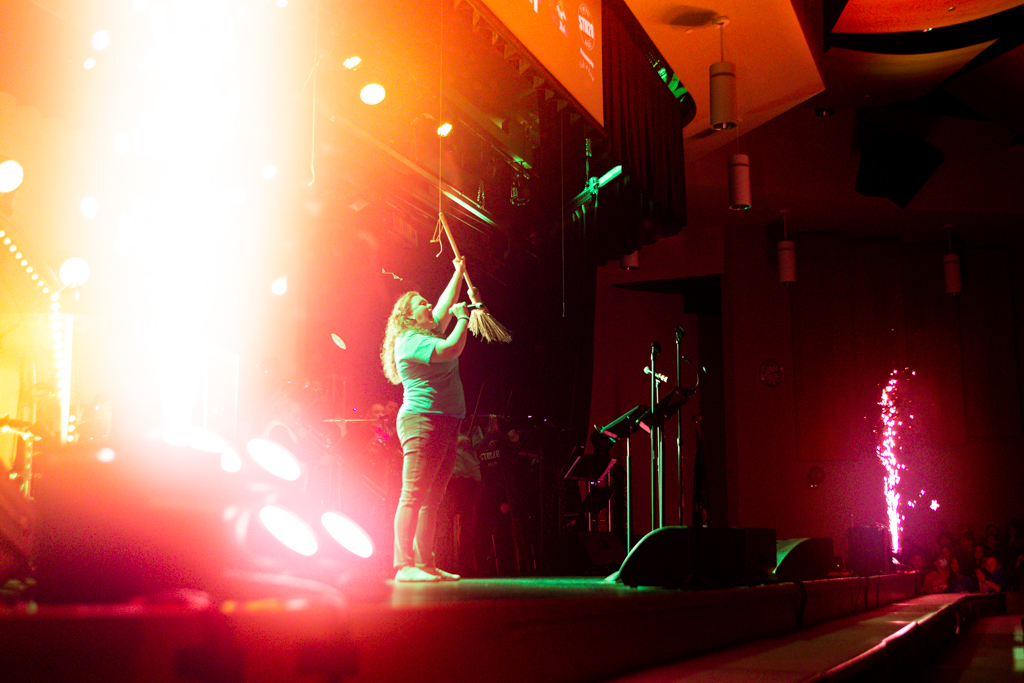
Because for the past two decades, the music teachers of Central Bucks School District in Bucks County, Pennsylvania, trade their classroom stage for the concert stage, talented musicians coming together to put on a performance that goes above and beyond their classroom commitments. What began as a simple recital with a small philanthropic element, has grown into an all-weekend, sold-out, four-show, two-and-a-half hour concert for students, community, and, ultimately, other school districts struggling to provide music programs for their own students. Oh yeah, that small philanthropic element has grown, too: the annual concert has raised more than $300,000 for the Save the Music Foundation, whose mission is to deliver equitable access to music education for millions of students nationwide.
The Save the Music Foundation is a nonprofit organization that was founded in 1997. Its goal is to ensure that music education is a core component of a well-rounded education for all children. The foundation operates in various communities across the United States, working to restore music education programs that have been cut or diminished due to budget constraints. A report from the National Association for Music Education found that between 2011 and 2014, nearly 90% of school districts in the United States experienced cuts to their music programs. This is a concerning trend, given the numerous benefits that music education can provide to students.
The foundation was created by John Sykes, the president of VH1 at the time. He was inspired to start the organization after he learned that many schools were cutting music programs in order to balance their budgets. Sykes believed that music education was an important part of a child’s development and he wanted to help ensure that children had access to it.
The foundation’s first major project was in New York City. In 1997, the foundation partnered with the New York City Department of Education to provide new musical instruments to public schools in the city. Over the next few years, the foundation expanded its work, partnering with school districts across the country to provide new musical instruments, professional development for music teachers, and support for music programs. In 2000, the foundation launched the “Adopt-A-School” program. This program allows businesses, individuals, and community organizations to support music education in a specific school by providing new musical instruments, funding for professional development, and support for music programs.
In addition to its programs, the foundation has also been a strong advocate for music education. The foundation has worked to raise public awareness about the importance of music education and has helped to promote music as a core component of a well-rounded education. The foundation has also been an advocate for music education at the federal level, working with policymakers to ensure that music education is a priority in the nation’s schools.
In recent years, a growing body of research has confirmed the numerous benefits that music education can provide to students of all ages. From improving academic performance to promoting social and emotional development, the impact of music education on students is significant and wide-ranging.
Studies have shown that students who participate in music education programs tend to perform better academically than their peers who do not. A report from the National Association for Music Education found that elementary school students who participate in music education programs score higher on reading and language arts tests than those who do not. Additionally, a study published in the Journal of Educational Psychology found that high school students who participated in music programs scored higher on standardized tests in both math and verbal sections compared to students who did not participate in music programs.
Music education can also have a positive impact on students’ social and emotional development. Participation in music programs can help students develop better teamwork skills, improve their self-esteem, and increase their overall sense of well-being. For example, a study published in the Journal of Research in Music Education found that participation in school music programs was positively associated with students’ self-esteem and their ability to work well with others.
Schools with music programs have an estimated 90.2% graduation rate and 93.9% attendance rate compared to schools without music education, which average 72.9% graduation and 84.9% attendance. Schools that have music programs have an attendance rate of 93.3% compared to 84.9% in schools without music programs.
The schools that produced the highest academic achievement in the United States today are spending 20% to 30% of the day on the arts, with special emphasis on music. ~ International Association for the Evaluation of Educational Achievement
Music enhances the process of learning. The systems they nourish, which include our integrated sensory, attention, cognitive, emotional and motor capacities, are shown to be the driving forces behind all other learning. ~ Konrad, R.R., Empathy, Arts and Social Studies
95% of Americans in a Gallup Poll believe that music is a key component in a child’s well-rounded education; three quarters of those surveyed feel that schools should mandate music education. ~ Gallup Poll, “American Attitudes Toward Music
Students of lower socioeconomic status who took music lessons in grades 8-12 increased their math scores significantly as compared to non-music students. But just as important, reading, history, geography and even social skills soared by 40%. ~ Gardiner, Fox, Jeffrey and Knowles
College-age musicians are emotionally healthier than their non-musician counterparts for performance anxiety, emotional concerns and alcohol-related problems. ~ Houston Chronicle
Research made between music and intelligence concluded that music training is far greater than computer instruction in improving children’s abstract reasoning skills. ~ Neurological Research, Vol. 1
Over the past two decades, the Save the Music Foundation has had a significant impact on the lives of children and communities across the country. The foundation has provided new musical instruments to thousands of schools, provided professional development for music teachers, and helped to ensure that music education is a priority in communities.
This is why the CB Save the Music concert is one of my favorite events on the calendar. Not just because I get to hear great music and have the privilege of making rock stars look like rock stars, but because I know the power music possesses to impact a child’s life. Both of my daughters are products of the dedicated teachers that take that stage. Their love of music, whether Harry or Hayden, is a big part of who they are today. Every kid should have that opportunity.
Yesterday, Central Bucks School District teachers and students protested Policy 321, a controversial rule enacted by the school board that bans teachers from talking about or displaying decor that advocates for “any partisan, political, or social policy issue.” The ban includes the display of Pride flags.
I was able to step out to record the protest, doing my small part to give voice to this issue and fight against the ignorance and hate that has permeated this once model school district.